What Mito Red Light does well
Mito Red Light sells three ranges from its own US store: the simple MitoMID 2.0, the smart MitoPRO X series and the flagship MitoADAPT 4.0 series. What sets the brand apart is documentation. For each panel we compared, it publishes two irradiance figures at 6 inches, one from a consumer solar meter and one from third-party spectroradiometer testing, and explains why they differ. That honesty is why all three Mito panels score well on our output disclosure criterion.
Across the range you also get free US shipping (lower 48 states), a 60-day money-back guarantee, FDA Class II registration and HSA/FSA eligibility, per Mito Red Light. Warranties are three years on the X and ADAPT ranges, two on the MitoMID 2.0.
The three panels we compared
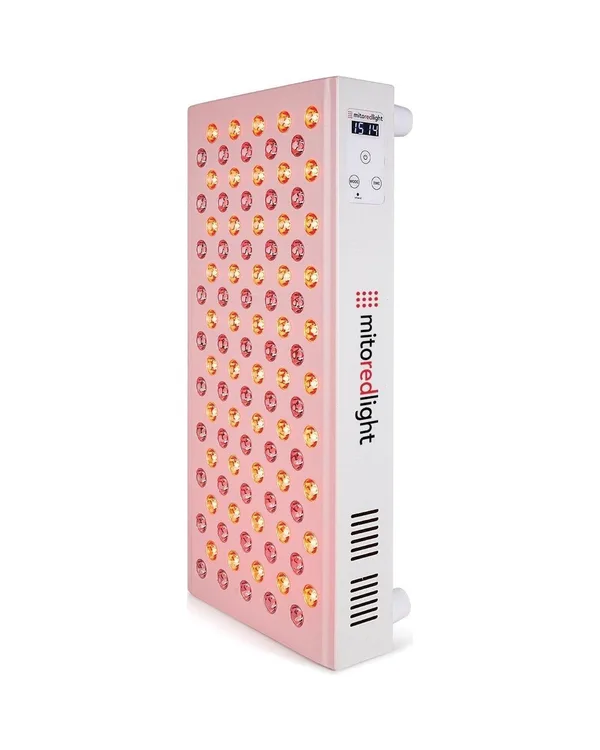
- MitoMID 2.0, $449: 9 × 19 inches, 100 LEDs at 660 and 850 nm, timer and three modes, no Bluetooth or Wi-Fi. Over 150 mW/cm² (consumer meter) and over 68 (lab) at 6 inches. 2-year warranty.
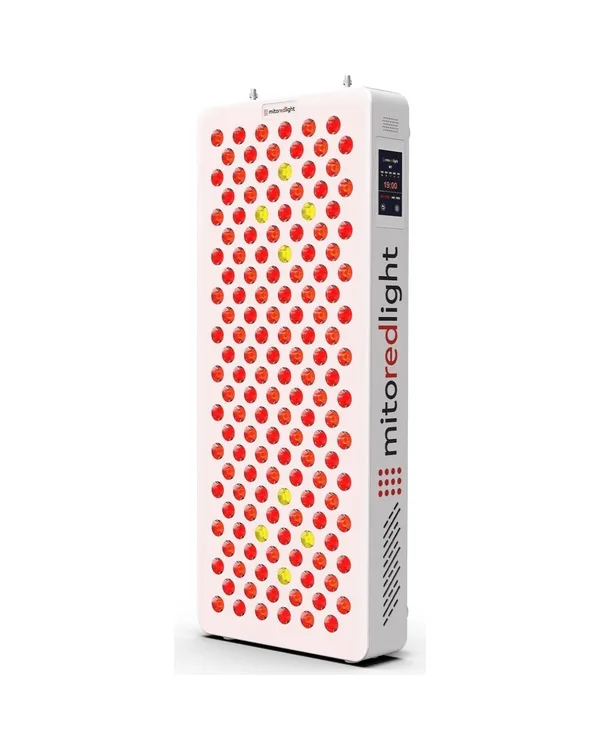
- MitoPRO 750X, $749: 10 × 23 inches, 150 dual-chip LED packages, six wavelengths (590 to 850 nm), touchscreen and app. Over 160 and over 70 mW/cm² at 6 inches. Flicker-free and no detectable EMF at 6+ inches, per Mito. 3-year warranty.
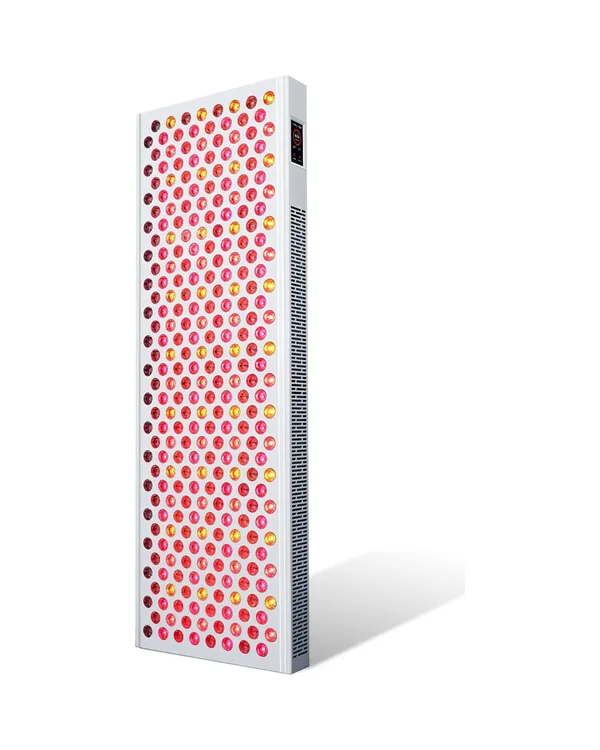
- MitoADAPT MAX 4.0, $1,499: 12 × 36 inches, 288 dual-chip packages, eight wavelengths (590 to 940 nm), eight circuits and 11 modes. Over 140 and over 60 mW/cm² at 6 inches. 3-year warranty.
Mito Red Light also sells other sizes we didn't score: a MitoPRO 300X for the face and neck ($449), a MitoPRO 1500X for the full body ($1,299), and smaller and larger MitoADAPT 4.0 panels and arrays (a MID and MAX 4.0 pair was $2,398). The size tables on the MitoPRO X and MitoADAPT pages help you pick.
Which Mito panel should you buy?
The MitoMID 2.0 if you want a simple half-body panel with honest lab data, under $500, and you like that it has no wireless radio. You give up the app, the extra wavelengths and a year of warranty.
The MitoPRO 750X if you want the best balance. For $300 more than the MitoMID you get six wavelengths, 100% red or 100% NIR modes, a touchscreen, an app with session tracking, a flicker-free statement and a third year of warranty. It's second in our overall ranking and first in our face and home use rankings.
The MitoADAPT MAX 4.0 if you want one panel for most of your body and every control: eight wavelengths, 11 modes, 36 inches. It's first in our full-body ranking. Budget $139 to $199 more for a floor stand.
Mito Red Light vs Hooga and Joovv
Against Hooga: Hooga is cheaper for the same size and publishes EMF figures (0.0 μT at 6 inches), with 3 years of warranty and 60-day returns too. Mito Red Light gives you more wavelengths, apps and lab-tested output. See MitoPRO 750X vs Hooga PRO750.
Against Joovv: Joovv has the polished app and the brand name, but costs far more per square inch ($5.39 for the Solo 3.0 against $3.26 for the MitoPRO 750X and $3.47 for the MitoADAPT MAX 4.0), gives two years of warranty and no distance for its irradiance figure. See MitoPRO 750X vs Joovv Solo 3.0.
Setting up a Mito panel at home
Mito Red Light ships its MitoPRO X and MitoADAPT panels with more in the box than most brands: protective goggles, IR3 glasses, an over-the-door hook, steel hanging cables and vinyl straps. That means you can hang the MitoPRO 750X on a door the day it arrives. A floor stand was $139 extra on November 12, 2026, and a heavy-duty version for the MitoADAPT MAX 4.0 was $199.
Plan for weight and power. Mito lists 9 lb and 150 W for the MitoMID 2.0, 15 lb and 225 W for the 750X, and 25 lb and 460 W for the MitoADAPT MAX 4.0. The two bigger panels have a touchscreen and a Bluetooth app, and Mito says Bluetooth can be switched off if you'd rather not have it on during a session. The MitoADAPT range links into multi-panel arrays with a wireless remote, so a second panel later doesn't mean starting over.
How Mito Red Light reports its numbers
This is where Mito stands out. For each panel it gives two irradiance figures at 6 inches: one from a consumer solar meter and one from third-party spectroradiometer testing. The MitoMID 2.0 reads over 150 on the meter and over 68 mW/cm² in the lab, the MitoPRO 750X over 160 and over 70, the MitoADAPT MAX 4.0 over 140 and over 60. The lab figure is less than half the meter figure, which is exactly why you should compare like with like. Rouge publishes the same kind of pair for the Pro G4 (164 and 90). Mito also says its X and ADAPT panels are flicker-free and emit no detectable EMF at 6 inches or more; the MitoMID page gives a magnetic field reading of 0.5 to 1 mG up close instead.
The catch with Mito Red Light
Three things to know. First, Mito Red Light costs more per square inch than Hooga, Rouge or PlatinumLED: $2.63 to $3.47 on the three panels we compared. Second, the stand is extra on the X and ADAPT panels. Third, the range is big and the names are similar (MID, MAX, X, ADAPT, MIN), so double-check the exact model and size in your cart.
None of that changes our view: if you value honest numbers and a long return window, Mito Red Light is one of the safest brands to buy from.
This guide is for buying decisions, not medical advice. If you are pregnant, have a skin or eye condition, or take medication that makes you sensitive to light, talk to your doctor before you start.
The panels in this guide, side by side
| Panel | MitoMID 2.08.9/10 | MitoPRO 750X9.5/10 | MitoADAPT MAX 4.09.5/10 |
|---|---|---|---|
| Price | $449 | $749 | $1,499 |
| Panel size | 9 × 19 in | 10 × 23 in | 12 × 36 in |
| Price per sq in | $2.63/sq in | $3.26/sq in | $3.47/sq in |
| Wavelengths | 660 + 850 nm | 6 wavelengths, 590–850 nm | 8 wavelengths, 590–940 nm |
| Irradiance (brand claim) | 150 mW/cm² at 6 in | 160 mW/cm² at 6 in | 140 mW/cm² at 6 in |
| EMF | 0.5–1 mG up close | Claim, no figure | Claim, no figure |
| Warranty | 2-year | 3-year | 3-year |
| Returns | 60 days | 60 days | 60 days |
| Buy | See price | See price | See price |